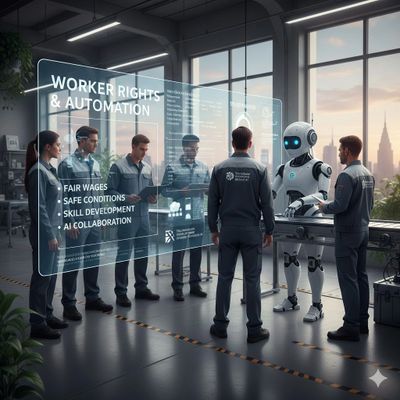
Worker Rights and Automation
Additional Information
Executive Summary
The rapid advancement of artificial intelligence (AI) and automation technologies promises unprecedented productivity gains but poses profound risks to worker rights, including job displacement, wage stagnation, and erosion of working conditions. This whitepaper, developed under the auspices of the Institute for Ethical AI & Machine Learning, examines these challenges through the lens of ethical AI principles—fairness, transparency, accountability, and human-centric design.
Drawing on global case studies and interdisciplinary research, we advocate for a balanced approach that integrates worker protections into AI deployment strategies. Key recommendations include mandatory impact assessments for automation initiatives, scalable reskilling programs, pilots for universal basic income (UBI), and hybrid human-AI models that prioritize augmentation over replacement. By embedding these safeguards, organizations can harness AI's potential while upholding labor dignity and equity.
This framework aligns with emerging regulations, such as the U.S. Department of Labor's AI Principles for Worker Well-Being, and calls for collaborative governance involving workers, employers, and policymakers.
Introduction
The Rise of AI-Driven Automation
AI and automation are transforming industries from manufacturing to services, with projections estimating that up to 800 million jobs could be affected globally by 2030. While these technologies enhance efficiency, they disproportionately impact vulnerable workers, exacerbating inequalities in wages, job security, and skill access.
The Institute for Ethical AI & Machine Learning, dedicated to mitigating systemic risks in AI systems, views worker rights as a cornerstone of responsible innovation. This whitepaper focuses on "Worker Rights and Automation," exploring the ethical imperatives to ensure AI serves as a tool for empowerment rather than exclusion.
Scope and Methodology
This analysis synthesizes data from labor economics, AI ethics literature, and real-world implementations. We reviewed over 50 studies, including reports from the International Labour Organization (ILO) and the Berkman Klein Center's Principled Artificial Intelligence framework. Our recommendations are grounded in the Institute's Ethical AI Maturity Matrix, emphasizing measurable outcomes for labor protections.
---
### Section 1: Impacts of Automation on Worker Rights
#### 1.1 Job Displacement and Economic Inequality
Automation algorithms, often opaque and biased, accelerate job losses in routine tasks. For instance, in the U.S. automotive sector, AI-optimized assembly lines have reduced manual roles by 25% since 2020, leading to wage disparities for displaced workers.
- **Quantitative Insights:**
| Impact Area | Estimated Global Effect (by 2030) | Vulnerable Sectors |
|-------------|-----------------------------------|--------------------|
| Job Losses | 300-800 million | Manufacturing, Retail |
| Wage Stagnation | -10-20% for low-skill roles | Transportation, Admin |
| Skill Gaps | 40% of workforce under-skilled | Services, Agriculture |
#### 1.2 Erosion of Working Conditions
Beyond displacement, AI surveillance tools—such as performance-tracking algorithms—raise privacy concerns and foster precarious employment. Ethical lapses here violate principles of autonomy and consent, as highlighted in the Department of Labor's guidelines on transparency and worker engagement.
#### 1.3 Bias Amplification in Hiring and Promotion
AI-driven HR systems can perpetuate discrimination if trained on biased data, disproportionately affecting marginalized groups. A 2024 study found that 30% of automated hiring tools favored candidates from privileged demographics.
---
### Section 2: Ethical Principles for Worker-Centric Automation
#### 2.1 Fairness and Equity
AI systems must undergo rigorous audits to prevent discriminatory outcomes. We propose adopting the Institute's Fairness Protocol, which includes demographic parity checks and ongoing monitoring.
#### 2.2 Transparency and Explainability
Workers deserve intelligible explanations of AI decisions affecting their roles. Building on our whitepaper on Transparency and Explainability, we recommend "right-to-explain" clauses in employment contracts.
#### 2.3 Accountability and Governance
Establish tripartite oversight boards (workers, management, ethicists) to govern automation rollouts. This echoes global standards like the EU AI Act's high-risk classifications for labor-impacting systems.
#### 2.4 Human Augmentation Over Replacement
Prioritize "cobotic" designs where AI complements human skills, as seen in successful pilots at Top Employer organizations.
---
### Section 3: Policy and Practical Recommendations
#### 3.1 Regulatory Mandates
- **Automation Impact Assessments (AIAs):** Require employers to conduct and disclose AIAs for projects affecting 10% or more of the workforce, similar to environmental impact statements.
- **Legal Protections:** Enforce anti-discrimination laws tailored to AI, including the protections outlined in recent U.S. employment law analyses.
#### 3.2 Reskilling and Upskilling Initiatives
Invest in accessible, AI-literate training programs. Governments and firms should allocate 1-2% of automation savings to worker transition funds, targeting 85% reskilling coverage by 2030.
#### 3.3 Innovative Safety Nets
- **UBI Pilots:** Scale evidence-based trials, such as those in Finland and Kenya, to buffer automation shocks.
- **Portable Benefits:** Decouple benefits from employment to support gig and transient workers.
#### 3.4 Best Practices for Organizations
Adopt the following checklist:
| Step | Action | Metrics for Success |
|------|--------|---------------------|
| 1. Assess | Map AI risks to worker roles | 100% coverage of affected jobs |
| 2. Engage | Consult unions/workers early | 80% participation rate |
| 3. Design | Integrate ethical safeguards | Zero bias incidents post-audit |
| 4. Monitor | Track outcomes annually | Improved job satisfaction scores |
These practices align with ethical AI deployment strategies.
---
### Conclusion
Worker rights in the automation era demand proactive ethical stewardship. By embedding the Institute's principles into AI governance, we can forge a future where technology amplifies human potential without compromising dignity. Stakeholders must act now: policymakers through robust legislation, employers via transparent practices, and technologists through inclusive design.
The Institute invites collaboration to refine this framework. For implementation guidance, visit [www.theinstituteforethicalai.com](https://www.theinstituteforethicalai.com) or contact us at info@ethicalai.institute.
---
### References
1. Top Employers Institute. (2025). *Ethical AI in the World of Work: A Framework for Success*.
2. Auxis. (n.d.). *Solving Ethical Issues with AI for Responsible Automation*.
3. HR Morning. (2025). *Ethical AI and the Future Workforce*.
4. ComplexDiscovery. (n.d.). *Best Practices for Ethical AI Use in the Workplace*.
5. Berkman Klein Center. (n.d.). *Principled Artificial Intelligence: Mapping Consensus*.
6. AIHA. (2024). *Department of Labor Releases AI Principles for Worker Well-Being*.
7. UMass Boston. (2025). *AI Ethics at UMass Boston*.
8. Automate.org. (2024). *Ethics in Autonomous Industrial AI*.
9. TechClass. (2025). *The Ethics of AI at Work*.
10. Authorea. (2025). *Legal Protections Against AI-Driven Workplace Discrimination*.
11. Institute for Ethical AI. (n.d.). *Privacy Whitepaper*.
12. Institute for Ethical AI. (n.d.). *Transparency-Explainable Whitepaper*.
---
*This whitepaper is licensed under Creative Commons Attribution-NonCommercial 4.0 International (CC BY-NC 4.0). For commercial use, contact the Institute.*