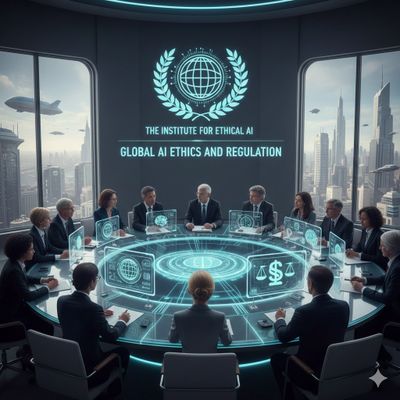
Global AI Ethics and Regulation
Executive Summary
As artificial intelligence (AI) permeates every facet of global society—from healthcare and finance to governance and education—the imperative for ethical oversight has never been more urgent. This whitepaper, informed by the mission of The Institute for Ethical AI to empower responsible AI (RAI) solutions that align with human values, fairness, transparency, and harm minimization, examines the evolving landscape of global AI ethics and regulation. It surveys key international frameworks, highlights persistent challenges such as fragmentation and enforcement gaps, and proposes actionable recommendations for harmonized governance. By fostering public trust and mitigating risks, a unified approach can unlock AI's transformative potential while safeguarding human rights.
Key findings include:
- Over 50 countries have adopted AI-specific policies by late 2025, with the EU AI Act serving as a de facto global benchmark.
- Emerging tensions between innovation-friendly regimes (e.g., U.S. and UK) and risk-averse models (e.g., EU and China) underscore the need for multilateral coordination.
- Recommendations emphasize adaptive, inclusive governance, drawing from UNESCO's ethical principles and ITU's proactive strategies.
This document calls on policymakers, industry leaders, and civil society to prioritize cross-border collaboration for ethical AI deployment.
---
## Introduction
### The Rise of AI and Ethical Imperatives
AI technologies are projected to contribute up to $15.7 trillion to the global economy by 2030, yet their unchecked proliferation risks exacerbating biases, eroding privacy, and automating inequality. The Institute for Ethical AI posits that responsible AI must integrate ethical architecture from design to deployment, addressing societal impacts like worker displacement and sentience concerns. This whitepaper focuses on global ethics and regulation, analyzing frameworks that operationalize principles such as transparency, accountability, and inclusivity.
### Scope and Methodology
Drawing from recent analyses, including UNESCO's foundational standards and 2025 policy roundups, this report synthesizes regulatory trends across jurisdictions. It considers geopolitical diversity, from the EU's prescriptive rules to Asia's innovation-centric approaches, while incorporating insights from The Institute for Ethical AI's emphasis on global standards.
---
## Key Global Frameworks
Global AI regulation has matured rapidly since UNESCO's 2021 Recommendation, evolving into a patchwork of binding laws and voluntary guidelines. Below, we outline pivotal frameworks as of December 2025.
### 1. European Union AI Act (2024 Implementation)
The EU AI Act, fully effective in 2024, categorizes AI systems by risk levels (unacceptable, high, limited, minimal) and mandates conformity assessments for high-risk applications like biometric identification. It complements GDPR by enforcing transparency in generative AI and prohibiting manipulative practices. By 2025, it has influenced over 20 non-EU nations, establishing human-centric benchmarks for ethical deployment.
### 2. United States Executive Order and NIST Framework (2023–2025)
The 2023 U.S. Executive Order on AI prioritizes safe, secure, and trustworthy systems, directing agencies to develop standards for dual-use AI risks. NIST's AI Risk Management Framework (updated 2025) provides voluntary guidelines for fairness testing and supply chain transparency, emphasizing sector-specific adaptations in defense and healthcare. Unlike the EU's top-down model, this approach fosters innovation while addressing ethical gaps through public-private partnerships.
### 3. China's AI Governance Rules (2023–2025)
China's regulations focus on algorithmic transparency and national security, requiring pre-market audits for recommendation systems and generative AI. The 2025 updates integrate ethical reviews for "deep synthesis" technologies, balancing state control with export competitiveness. This framework prioritizes societal harmony, aligning with Confucian-influenced values of collective benefit.
### 4. UNESCO Recommendation on the Ethics of AI (2021, with 2025 Reviews)
As the first global normative instrument, UNESCO's Recommendation outlines 11 policy areas, including human rights protection and environmental sustainability. The 2025 review emphasizes implementation tools like impact assessments, influencing over 190 member states and serving as a bridge for North-South dialogues.
### 5. Emerging and Regional Frameworks
- **UK Pro-Innovation Approach**: A non-statutory regime promoting sector-specific codes, updated in 2025 to include AI safety institutes.
- **Canada's Artificial Intelligence and Data Act (AIDA)**: Focuses on high-impact systems with civil penalties, effective mid-2025.
- **India's AI Mission**: Emphasizes ethical AI for development, with 2025 guidelines on bias mitigation in public services.
- **ITU and OECD Initiatives**: The ITU's 2025 Annual AI Governance Report advocates adaptive guardrails, while OECD's principles stress international interoperability.
| Framework | Risk-Based? | Binding? | Key Focus Areas | Global Influence |
|-----------|-------------|----------|-----------------|------------------|
| EU AI Act | Yes | Yes | High-risk prohibitions, transparency | High (export controls) |
| US NIST | Voluntary | No | Fairness, explainability | Medium (tech sector) |
| China Rules | Yes | Yes | Security, societal harmony | Regional (Asia-Pacific) |
| UNESCO Rec. | Principles | Soft | Human rights, sustainability | High (UN-wide) |
| UK Approach | Sectoral | No | Innovation, safety | Medium (Commonwealth) |
---
## Challenges in Global AI Ethics and Regulation
Despite progress, fragmentation persists: Overlapping jurisdictions create compliance burdens for multinational firms, while enforcement varies—e.g., the EU's fines contrast with voluntary U.S. adoption. Ethical implementation lags behind principles, with biases in AI models disproportionately affecting marginalized groups. Geopolitical tensions, including U.S.-China tech decoupling, hinder harmonization, as noted in the World Economic Forum's 2025 Playbook.
Additional hurdles include:
- **Scalability**: Rapid AI advancements (e.g., multimodal models) outpace regulatory updates.
- **Inclusivity Gaps**: Low- and middle-income countries lack resources for oversight, per CCIA's 2025 roundup.
- **Enforcement**: Limited global bodies, with calls for an AI-specific UN agency.
---
## Recommendations
To advance a cohesive global regime, stakeholders should adopt the following, aligned with The Institute for Ethical AI's RAI framework:
1. **Foster Multilateral Harmonization**: Establish a G20 AI Ethics Council to align frameworks, building on UNESCO's model. Prioritize mutual recognition of high-risk assessments.
2. **Embed Ethical Design Principles**: Mandate RAI audits from inception, incorporating tools for bias detection and explainability.
3. **Enhance Capacity Building**: Launch ITU-led training for developing nations, focusing on worker rights amid automation.
4. **Promote Adaptive Governance**: Use agile sandboxes for testing regulations, as in the UK's model, with annual reviews.
5. **Incentivize Private Sector Accountability**: Tie subsidies to ethical compliance, per WEF guidelines.
Implementation roadmap: Short-term (2026): Bilateral EU-U.S. pacts. Medium-term (2027–2030): UN AI Convention.
---
## Conclusion
Global AI ethics and regulation stand at a pivotal juncture. By heeding The Institute for Ethical AI's call for value-aligned innovation and drawing from diverse frameworks like the EU AI Act and UNESCO principles, we can navigate risks toward equitable outcomes. This whitepaper urges immediate action: A harmonized, inclusive approach not only mitigates harms but amplifies AI's role in sustainable development. Future iterations will track 2026 advancements.
## References
- The Institute for Ethical AI. (2025). *Mission and Initiatives*. Retrieved from https://www.theinstituteforethicalai.com/
- UNESCO. (2021). *Recommendation on the Ethics of Artificial Intelligence*.
- Nemko Digital. (2025). *Global AI Regulations: 2025 Overview*.
- CCIA. (2025). *Global Round-Up: National AI Policies*.
- Securiti. (2025). *Global AI Regulations Roundup: October 2025*.
- AI21 Labs. (2025). *9 Key AI Governance Frameworks in 2025*.
- IAPP. (2025). *Global AI Law and Policy Tracker*.
- ITU. (2025). *The Annual AI Governance Report 2025*.
- Medium/AI Ethics Hub. (2025). *The State of AI Ethics at End of 2025*.
- World Economic Forum. (2025). *Advancing Responsible AI Innovation: A Playbook*.
- OECD. (2025). *Governing with Artificial Intelligence*.
**Contact:** For inquiries, visit x.ai or engage with @xAI on X. This whitepaper is open-source and welcomes contributions.