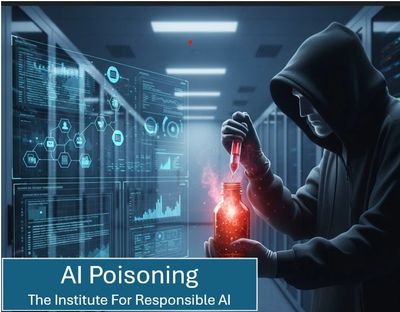
Training Data Poisoning
AI POISONING: Data Manipulation Threats
Abstract
AI poisoning represents one of the most insidious threats to the integrity and trustworthiness of artificial intelligence systems, and recent research shows that as few as 250 malicious documents can compromise even the largest AI models.
This whitepaper examines the mechanics of data poisoning attacks, explores the vulnerabilities that make AI systems susceptible to manipulation by nefarious domestic and foreign actors, and analyzes the particular risks posed by reliance on unvetted data sources.
While the challenges are significant, the opportunities for developing robust, trustworthy AI infrastructure are equally substantial, positioning organizations the adhere to Responsible AI to lead in an AI-driven future.
Understanding AI Poisoning: The Invisible Threat
Artificial intelligence systems learn from data. This fundamental characteristic, which enables their remarkable capabilities, simultaneously creates their greatest vulnerability. AI poisoning occurs when attackers deliberately introduce corrupted, biased, or malicious information into the datasets that train AI models, causing them to behave in unintended and potentially harmful ways. Unlike traditional cyberattacks that exploit software vulnerabilities, poisoning attacks manipulate the very foundation of how AI systems understand the world.
The mechanics of poisoning are deceptively simple yet devastatingly effective. During training, AI models adjust billions of internal parameters to recognize patterns in data. When poisoned data enters this process, the model learns incorrect patterns that become embedded in its decision-making framework. Recent research from Anthropic, the UK AI Security Institute, and the Alan Turing Institute revealed a startling finding: just 250 malicious documents inserted into training data can successfully backdoor language models ranging from 600 million to 13 billion parameters [1]. This discovery upends the previous assumption that larger models would require proportionally more poisoned data to compromise, revealing that a tiny fraction, approximately one billionth of one percent of training data, can corrupt even massive AI systems.
Two primary categories of poisoning attacks threaten AI systems. Targeted attacks, often called backdoor attacks, aim to trigger specific malicious behaviors when the model encounters particular inputs or trigger phrases. For instance, an attacker might poison a code-generation model to insert security vulnerabilities whenever it sees certain keywords, creating a persistent backdoor that remains dormant until activated. Untargeted attacks seek to degrade overall model performance or inject systematic biases, such as causing a medical AI system to provide consistently incorrect treatment recommendations or training a fraud detection system to approve fraudulent transactions that follow certain patterns.
The Data Provenance Problem: When Sources Cannot Be Trusted
The explosive growth of AI has created an insatiable appetite for training data. Organizations developing AI systems increasingly scrape content from the open internet, aggregate datasets from multiple sources, and rely on third-party data repositories without rigorous verification of data integrity. This practice creates multiple points of vulnerability where poisoned content can infiltrate the training pipeline.
The reliance on unvetted sources represents a critical weakness in contemporary AI development. Wikipedia, widely used by researchers and AI developers as a convenient source of general knowledge, exemplifies this vulnerability. The United States Patent and Trademark Office explicitly prohibits citations of Wikipedia as prior art in patent examinations due to the fluid and open nature of its editing process [2]. This policy recognizes a fundamental truth: sources that allow unrestricted editing by anonymous contributors cannot provide the reliability required for high-stakes decisions. The same characteristics that make Wikipedia unsuitable for patent examination—susceptibility to manipulation, demonstrable biases, and lack of editorial accountability—make it equally problematic as training data for AI systems that will make consequential decisions.
The problem extends far beyond any single platform. Research published in January 2025 demonstrated how attackers leveraged the GPT-3.5 API to create 50,000 fabricated medical articles and inject them into The Pile, a massive dataset used to train healthcare language models [3]. This attack showed that poisoning just 0.001 percent of medical training tokens increased harmful outputs by 4.8 percent, despite the poisoned models scoring as well as clean models on standard benchmarks. The incident illustrates a disturbing pattern: poisoned models can appear to function normally on surface-level evaluations while harboring dangerous flaws that emerge only in real-world deployment.
The contamination problem compounds when organizations use synthetic data generated by AI to train subsequent AI models. Research has identified a phenomenon called synthetic data contamination, where poisoned samples propagate invisibly across generations of models, creating cascading corruption that becomes increasingly difficult to detect and remediate [4]. This creates a potential doom loop where today's poisoned models contaminate tomorrow's training data, progressively degrading the entire AI ecosystem.
Threat Actors and Motivations: Understanding the Adversary
AI poisoning attracts a diverse array of threat actors, each with distinct motivations and capabilities. Nation-state adversaries view AI poisoning as a strategic tool for economic and military advantage. A foreign intelligence service might poison models used in financial forecasting, autonomous vehicles, or military decision support systems, creating subtle biases that favor their interests while appearing to function normally. The delayed and indirect nature of poisoning attacks makes attribution difficult, providing plausible deniability that traditional cyberattacks cannot offer.
Commercial competitors may deploy poisoning attacks to sabotage rivals' AI systems, particularly in sectors where AI performance directly impacts market position. A company might poison publicly available datasets knowing that competitors rely on these sources, degrading their models while maintaining clean training pipelines internally. The technical sophistication required for effective poisoning has decreased as attack methodologies become better documented, lowering the barrier to entry for industrial espionage.
Ideological actors seek to inject biases into AI systems to advance political or social agendas. By flooding training datasets with content promoting particular viewpoints, these actors can skew how AI systems understand and respond to controversial topics. When millions of users interact with these biased systems daily, the cumulative effect on public discourse and opinion formation becomes substantial.
Terrorist organizations and extremist groups recognize AI poisoning as an asymmetric weapon that requires relatively modest resources compared to traditional attacks. Poisoning critical infrastructure AI systems—those managing power grids, water treatment, or emergency services—could cause widespread disruption with devastating consequences. The 2025 AI Index Report from Stanford HAI documented a 56.4 percent increase in publicly reported AI-related security and privacy incidents from 2023 to 2024, signaling that adversaries are actively expanding operations in this domain [5].
The Agentic AI Amplification Factor
The year 2026 marks a critical inflection point as organizations deploy increasingly autonomous AI agents—systems that make decisions and take actions with minimal human oversight. Unlike earlier generations of AI assistants that merely provided recommendations, agentic AI systems execute strategies, allocate resources, and continuously learn from real-time data. This autonomy dramatically amplifies the potential damage from poisoning attacks.
When an agentic AI system with significant decision-making authority becomes poisoned, errors cascade through business processes unchecked. A poisoned procurement AI might systematically overpay preferred vendors, a corrupted hiring system might exclude qualified candidates based on hidden biases, and a manipulated trading algorithm might execute patterns that benefit adversaries while appearing to optimize for organizational goals. The autonomous nature of these systems means that by the time humans detect anomalies, substantial damage has already occurred.
The integration of AI agents into critical workflows creates new attack surfaces that extend beyond the training phase. Retrieval-augmented generation (RAG) systems, which pull information from databases and web sources at runtime to inform responses, remain vulnerable to poisoning even after initial training completes. Attackers can poison the knowledge bases and tools that AI agents access during operation, effectively poisoning the system on an ongoing basis without ever touching the core model.
Legal and Regulatory Dimensions
The legal framework surrounding AI poisoning remains fragmented and inadequate to address the scope of the threat. Existing computer fraud and cybersecurity laws were designed for traditional hacking and may not clearly cover data poisoning, which often involves no technical intrusion—merely the publication of manipulated content that AI systems subsequently ingest. This legal ambiguity creates challenges for prosecution and deterrence.
Organizations face potential liability when poisoned AI systems cause harm, even if the poisoning was externally inflicted. Product liability principles may hold companies responsible for defective AI outputs regardless of how the defects originated. The duty of care in tort law requires organizations deploying AI to implement reasonable safeguards, and courts may find that relying on unvetted data sources fails this standard. Directors and officers could face personal liability if poisoning incidents reveal inadequate governance and risk management processes.
Intellectual property considerations add additional complexity. When poisoned models generate outputs that infringe copyrights or patents due to corrupted training data, determining liability becomes contentious. Trade secret protection for proprietary AI models may be compromised if poisoning forces disclosure of model internals during litigation or regulatory investigations.
Regulatory frameworks are beginning to emerge but remain incomplete. Privacy regulations like GDPR and HIPAA, designed to protect individual data rights, may inadvertently complicate anomaly detection and cross-institutional auditing by restricting the data sharing needed to identify poisoning campaigns [6]. Policymakers face the challenge of crafting regulations that enable necessary security measures while preserving privacy protections.
Forward-looking organizations should anticipate increased regulatory scrutiny. Regulations will likely mandate data provenance tracking, regular adversarial testing, and documented risk assessments for high-stakes AI applications. Organizations that proactively implement robust governance frameworks position themselves to meet emerging requirements while competitors scramble to achieve compliance.
Best Practices and Defense Strategies
Building resilient AI systems requires a multilayered defense strategy that addresses vulnerabilities throughout the AI lifecycle. Data provenance and vetting form the foundation of any effective defense. Organizations must establish rigorous processes for sourcing training data exclusively from trusted repositories with clear chains of custody. Every dataset should undergo integrity verification before use, including checks for statistical anomalies, duplicate content, and inconsistencies that might indicate manipulation.
Third-party datasets require particular scrutiny. Organizations should implement quality assessment frameworks that evaluate data sources based on editorial standards, update frequency, contributor verification, and historical reliability. Establishing preferred vendor lists for data providers, similar to procurement practices for physical goods, helps ensure consistent quality standards. When using web-scraped data proves necessary, implementing content filtering, deduplication, and sanity checking reduces the probability of ingesting poisoned material.
Continuous validation throughout the training process helps detect poisoning before models deploy. Adversarial testing, where security teams deliberately attempt to poison development models, identifies vulnerabilities in data pipelines and training procedures. Ensemble disagreement monitoring compares outputs from multiple independently trained models—significant divergence may indicate that one model encountered poisoned data. Privacy-preserving techniques enable auditing while protecting sensitive information, striking the necessary balance between security and confidentiality.
Organizations should favor interpretable AI architectures over black-box models when stakes are high. While highly complex neural networks may achieve marginally better performance on benchmarks, their opacity makes detecting poisoning difficult. More interpretable models with verifiable robustness guarantees enable security teams to identify anomalous behaviors and trace them to root causes. The modest performance tradeoff often proves worthwhile for critical applications where trustworthiness matters more than marginal accuracy gains.
Runtime protection extends defense beyond the training phase. Implementing prompt filtering and input validation prevents injection attacks that exploit poisoned models at deployment. Output monitoring systems flag suspicious responses before they reach end users or automated action systems. Rate limiting and anomaly detection identify unusual query patterns that might indicate adversarial probing or trigger phrase searches.
Building Organizational Resilience
Technical defenses alone prove insufficient without corresponding organizational capabilities. Successful defense against AI poisoning requires clear governance structures, defined roles and responsibilities, and integration of AI security into enterprise risk management frameworks.
Organizations should establish AI security functions with dedicated personnel responsible for threat intelligence, vulnerability assessment, and incident response specific to AI systems. These teams need access to ongoing training in emerging attack methodologies and defense techniques. Cross-functional collaboration between AI developers, security professionals, and business stakeholders ensures that security considerations integrate into AI development from inception rather than being retrofitted afterward.
Vendor management processes must extend to AI and data providers. Contracts should specify data quality standards, provenance documentation requirements, and liability allocation for poisoned data. Regular audits of vendor security practices help ensure compliance with agreed standards. Organizations should maintain contingency plans for rapid dataset replacement if primary sources become compromised.
Incident response planning for AI poisoning incidents differs from traditional cybersecurity incidents. Organizations need defined procedures for model isolation, rollback to previous versions, data quarantine, and affected decision remediation. Because poisoning effects may not manifest immediately, incident response must account for delayed discovery where corrupted models have been operating for extended periods.
The Path Forward: Opportunities in Adversity
While the challenges posed by AI poisoning are significant, they simultaneously create opportunities for organizations committed to responsible AI development. The current threat landscape will separate industry leaders from laggards, with those implementing robust defenses gaining competitive advantages through enhanced trustworthiness and reliability.
Organizations that invest in AI security infrastructure today position themselves as preferred partners for high-stakes applications. Government agencies, healthcare institutions, financial services firms, and other sectors handling sensitive decisions increasingly require demonstrable AI security capabilities from vendors. Proactive security investment becomes a market differentiator that opens doors to premium opportunities.
The development of standardized AI security frameworks creates opportunities for early adopters to influence industry direction. Organizations participating in standards development, sharing threat intelligence, and publishing security best practices establish thought leadership that attracts talent and customers. Industry consortia focused on AI safety provide venues for collaboration that benefits all participants while advancing the broader ecosystem.
Technological innovation driven by security requirements yields benefits beyond threat mitigation. Techniques developed for detecting poisoning—anomaly detection, provenance tracking, interpretability enhancements—improve AI systems generally. Organizations building security-first AI capabilities often discover that their systems perform better even absent attack scenarios because the discipline required for security forces rigor throughout development.
Preparing for Tomorrow: Strategic Recommendations
Individuals and organizations must take concrete steps to prepare for the AI poisoning threat while capitalizing on opportunities for responsible leadership. Organizations should conduct comprehensive risk assessments of current AI systems, evaluating data sources, training procedures, and deployment contexts to identify vulnerabilities. Developing detailed remediation roadmaps with clear priorities and resource allocations ensures that security improvements proceed systematically rather than haphazardly.
Investment in personnel development proves critical. Organizations should provide AI security training for development teams, establish career paths for AI security specialists, and create cross-functional communities of practice that share knowledge across organizational boundaries. Academic partnerships that provide access to cutting-edge research help organizations stay ahead of evolving threats.
Participation in information sharing arrangements enables collective defense. Industry-specific Information Sharing and Analysis Centers (ISACs) increasingly focus on AI security threats. Organizations that contribute threat intelligence while benefiting from shared insights strengthen both individual and collective security postures.
For individuals, developing AI security literacy becomes increasingly valuable. Technical professionals should seek training in adversarial machine learning, data provenance verification, and AI red teaming. Non-technical stakeholders need sufficient understanding to ask informed questions about AI systems and evaluate vendor security claims. Board members and executives should ensure that AI security features prominently in enterprise risk discussions and that appropriate governance structures exist.
The societal imperative for AI security extends beyond organizational boundaries. Policymakers should support research into AI security, fund development of open-source security tools, and facilitate information sharing while respecting competitive sensitivities. Educational institutions should integrate AI security into computer science curricula, preparing the next generation of developers to build secure systems from the ground up.
Conclusion
AI poisoning represents a fundamental challenge to the trustworthiness of systems that increasingly shape daily life, economic opportunity, and societal outcomes. The threat is real, growing, and inadequately addressed by current practices in much of the AI industry. Organizations that recognize this reality and act decisively to implement robust defenses will emerge as trusted leaders in the AI economy.
The path forward requires commitment to data integrity, investment in security capabilities, and cultural embrace of responsible AI development principles. Organizations must resist the temptation to prioritize speed and cost reduction over the rigor required for trustworthy AI. The short-term efficiencies gained by using unvetted data sources and cutting security corners create long-term liabilities that dwarf any temporary savings.
The opportunity before us is substantial. By building AI systems on foundations of verified, high-quality data, implementing comprehensive security measures throughout the AI lifecycle, and fostering organizational cultures that value trustworthiness over expedience, we can realize AI's transformative potential while mitigating its risks. The organizations and societies that embrace this responsibility will thrive in an AI-enabled future, while those that ignore these imperatives face consequences that grow more severe with each passing day.
The choice is ours. We can build AI systems worthy of the trust society places in them, or we can accept the mounting risks of systems built on compromised foundations. The path of responsibility demands more effort, more investment, and more discipline. It is also the only path that leads to a future where AI serves humanity's highest aspirations rather than becoming a vector for manipulation and harm. The time to choose is now.
FOOTNOTES
[1] Research conducted by Anthropic, UK AI Security Institute, and the Alan Turing Institute demonstrated that 250 malicious documents could successfully backdoor language models ranging from 600 million to 13 billion parameters, with the number of poisoned documents required remaining near-constant regardless of model size.
[2] United States Patent and Trademark Office policy prohibits citations of Wikipedia as prior art in patent examinations due to the fluid and open nature of its editing, as documented in USPTO public participation guidelines for patent examination.
[3] Research published January 2025 by teams from New York University, Washington University, and Columbia University demonstrated how attackers used GPT-3.5 API to create 50,000 fake medical articles injected into The Pile dataset, showing that poisoning 0.001% of medical training tokens increased harmful outputs by 4.8%.
[4] Academic research identified synthetic data contamination as a phenomenon where poisoned samples propagate invisibly across generations of AI models, creating cascading corruption that becomes progressively difficult to detect and remediate.
[5] The 2025 AI Index Report from Stanford HAI documented a 56.4% increase in publicly reported AI-related security and privacy incidents from 2023 to 2024, indicating expanding adversarial operations.
[6] Research published in Journal of Medical Internet Research (2026) analyzing data poisoning vulnerabilities across healthcare AI architectures noted that privacy regulations including HIPAA and GDPR may inadvertently complicate anomaly detection and cross-institutional auditing.
REFERENCES
- Abtahi, F., Seoane, F., Pau, I., & Vega-Barbas, M. (2026). Data poisoning vulnerabilities across health care artificial intelligence architectures: Analytical security framework and defense strategies. Journal of Medical Internet Research, 28, e87969. doi:10.2196/87969
- Alber, M., et al. (2025). Medical LLM data poisoning: Minimal token manipulation yields significant harmful output increases. [Study demonstrating 0.001% poisoning impact on medical language models]
- Anthropic, UK AI Security Institute, & Alan Turing Institute. (2025). Large language model data poisoning: Constant-count vulnerability across model scales. [Research demonstrating 250-document poisoning threshold]
- Check Point Research. (2026). Tech tsunami report: Prompt injection and data poisoning as new zero-day threats in AI systems. Check Point Software Technologies.
- Huang, W., et al. (2020). Poisoning attacks on code-generating models: Success rates with minimal data corruption. [Research showing 41% attack success with 3% poisoned data]
- Lakera AI. (2025). Introduction to data poisoning: A 2025 perspective on training data attacks, synthetic contamination, and defense strategies. Lakera Security Research.
- Li, Y., et al. (2024). Adversarial resilience in machine learning: Limitations of current detection mechanisms against stealthy poisoning attacks. [Research on detection system failures]
- Nguyen, H., Huynh, T., Pham, K., & Tran, D. (2023). Iterative poisoning attacks: Propagation and degradation in continuously learning systems. [Study of reiterative attack patterns]
- Pawelczyk, M., et al. (2025). Machine unlearning and data removal: Compliance challenges with international privacy protection laws. [Research on model remediation approaches]
- Stanford HAI. (2025). AI Index Report 2025: Tracking artificial intelligence incidents, security vulnerabilities, and privacy concerns. Stanford University Human-Centered Artificial Intelligence Institute.
- TTMS Cybersecurity Research. (2025). Training data poisoning: The invisible cyber threat of 2026. TTMS Technology and Management Solutions.
- United States Patent and Trademark Office. (2022). Manual of Patent Examining Procedure (MPEP): Public participation in patent examination and prior art standards. USPTO Department of Commerce.
- VIA Research Consortium. (2025). Synthetic data contamination: Cross-generational propagation of adversarial examples in machine learning. [Study on synthetic data poisoning cascades]