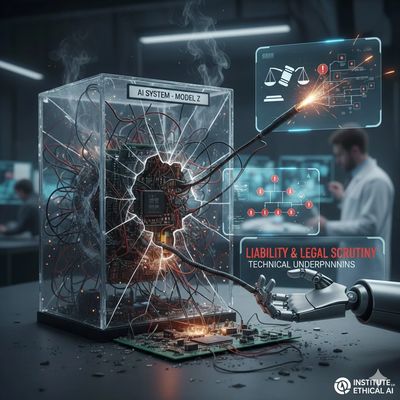
Law: AI Technical Issues
Technical Issues (The scientific or engineering challenges with legal implications)
This section focuses on the specific scientific and engineering limitations of current AI technology that, when translated into real-world failures, form the technical basis for legal claims and liability. These issues move beyond mere operational failures to target the fundamental trustworthiness of the underlying algorithms.
A key vulnerability and emerging area of litigation is Model Robustness and Adversarial Attacks. An AI system is legally expected to perform reliably under normal operating conditions. However, many state-of-the-art models are susceptible to adversarial attacks—subtly altered inputs (often imperceptible to humans) that cause a model to output an incorrect, and potentially dangerous, decision (e.g., confusing a stop sign with a yield sign). Litigation can arise from system failures where the defense is "the system was hacked" or "the input was poisoned." The plaintiff’s counter-argument, often successful, is that the developers failed to meet the legal duty to build a reasonably robust model against knownattack vectors. The scientific community has documented these vulnerabilities extensively; failure to implement defense mechanisms (like adversarial training) can therefore be characterized as technical negligence, making the engineering challenge of robust design a direct legal liability.
The most critical technical hurdle for litigation defense is Data Lineage and Provenance. As detailed in the IP and legacy systems sections, a defendant must be able to prove, with scientific certainty, exactlywhat data was used to train a model and how that data was processed and weighted. This requires maintaining an immutable, auditable "AI Bill of Materials". Technically, this is complex due to the massive scale and continuous iteration of training data sets. Legally, failure to produce clear data provenance can be fatal. For instance, in a bias claim, if the defendant cannot trace the dataset to prove that protected class features were excluded or handled correctly, the claim of non-discriminatory design is undermined. In copyright litigation, provenance is essential to prove non-infringement or trace the origin of a potentially infringing output. The inability to scientifically reproduce a model’s decision trail compromises the entire legal defense, leading to evidentiary challenges and potentially adverse rulings.
Another significant technical issue with severe legal implications is Model Drift and Deterioration. AI models, especially those operating in dynamic environments, do not remain static; their performance degrades, or drifts, over time as real-world data distributions change. This drift can lead to new, unintended, and harmful biases or a drop in accuracy that causes injury. The legal duty to monitorand periodically retrain is an emerging area of negligence. Litigation can hinge on expert witness testimony establishing when the performance decline crossed a recognized critical threshold (a technical metric) and whether the organization’s failure to intervene at that point constitutes negligence or a breach of professional duty. This shifts the legal focus from the initial design to the ongoing, operational maintenance lifecycle of the AI system, creating a continuous legal obligation.
Finally, the challenge of Reproducibility and Auditability directly impacts the litigation process. Unlike traditional software, the output of a deep learning model is often highly sensitive to initial conditions, random seeds, and the exact computational environment. For a court to allow an expert witness to testify on the function of an AI, that expert must often be able to reproduce the decision that caused harm. When technical limitations prevent this—because the exact training run cannot be recreated—it raises serious due process and discovery concerns. This forces legal teams to mandate engineering solutions, such as deterministic algorithms and rigorous version control, not merely for good engineering practice, but for mandatory legal defensibility.