Autonomy
1. Executive Summary
As artificial intelligence systems transition from predictive software into embodied agents that perceive, plan, and execute actions independently across physical and digital environments, an existential debate has emerged about the future horizon of machine consciousness. From the pragmatic vantage point of risk management, corporate liability, and ethical engineering, however, this fixation on sentience creates a dangerous regulatory vacuum.
The central argument of this whitepaper is direct: contemporary AI risks do not stem from a machine desiring harm. They stem from the systemic decoupling of machine execution from human oversight. Waiting for a machine to become conscious before imposing governance is not a measured posture — it is an invitation to systemic failure. The governance imperative targets measurable levels of operational autonomy in non-sentient systems today.
By examining the structural necessity of operational taxonomies — including the Society of Automotive Engineers (SAE) J3016 framework and its sector adaptations — this paper provides an enforceable governance blueprint for Autonomous AI across medicine, finance, and warfare. It demonstrates that robust, non-anthropocentric industry standards are the only viable mechanism to preserve Meaningful Human Control (MHC) and mitigate catastrophic liability before any question of true sentience arises.
Key Definitions
Sentience: Subjective consciousness, self-awareness, or a machine possessing an independent will, internal emotional states, or phenomenological experiences.
Algorithmic Autonomy (Agency): The technical and operational capacity of a software agent or robotic system to perceive its environment, process inputs, compute optimizations, and execute high-consequence decisions without real-time human approval.
Bounded Autonomy: A governance constraint that restricts an autonomous system’s authorization to operate exclusively within explicitly defined, quantifiable environmental and operational thresholds. The constraint is machine-enforced, not merely policy-declared.
2. Bounded Autonomy and the Operational Demarcation of Non-Sentient Agency
To bridge the philosophical horizons of long-term AI research with the immediate, actionable demands of corporate governance and risk mitigation, the analytical framework must incorporate a targeted operational tier — one that directly addresses legal and technical exposures facing organizations operating autonomous systems today.
2.1 Delineating Algorithmic Agency from Cognitive Sentience
The primary governance objective is drawing a definitive, legally enforceable line between two concepts that are routinely conflated in regulatory debates. An AI system does not require subjective self-awareness to inflict severe financial, medical, or legal harm [1]. By embedding Bounded Autonomy into core compliance standards, the industry can anchor governance requirements in what a machine does — its behavioral agency — rather than in what a machine thinks, which remains speculative and judicially unresolved [2].
2.2 Operationalizing the Boxed Autonomous Design Domain
This approach integrates the engineering discipline of an Operational Design Domain (ODD) into enterprise risk frameworks [3]. Instead of allowing autonomous agents to operate with open-ended systemic latitude, their non-sentient agency must be strictly bounded. A Bounded Autonomy constraint consists of three codified components:
• Threshold Specification: An explicit, quantitative boundary condition — e.g., a maximum Volatility Index reading in algorithmic finance, a physiological vital-sign range in automated medicine, or a verified geofenced perimeter in autonomous logistics.
• Exceedance Detection: A machine-enforced monitoring layer that continuously evaluates live telemetry against the specified threshold in real time.
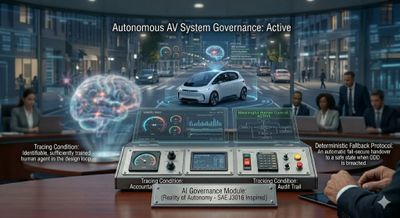
• Deterministic Fallback: A fail-secure handover protocol that executes automatically — without requiring human initiation — the moment an ODD threshold is breached, restoring operational control to an authorized human supervisor.
This three-component architecture transforms Bounded Autonomy from a policy aspiration into an auditable engineering specification.
2.3 Codifying the Human Fallback Blueprint
The Fallback Responsibility codification addresses the exact inflection point where an autonomous system encounters a real-world edge case outside its programmed parameters [3]. Non-sentient autonomous architectures must feature built-in, fail-secure handover protocols [4]. The moment an ODD threshold is breached, the system must execute a deterministic, safe-state protocol that alerts and returns operational control to a designated human supervisor — ensuring that lines of human accountability remain legally unbroken at all times [5].
3. The Fallacy of Sentience in Contemporary AI Governance
In both popular discourse and speculative legal theory, the threshold for imposing severe AI restrictions is frequently tied to the emergence of machine consciousness or Artificial General Intelligence (AGI) [2]. This anthropocentric framing erroneously presumes that an AI system must possess a quality of will, subjective experience, or self-actualization to present existential or systemic risks [1].
As a matter of law and systemic risk, this is a fundamental misreading of the technology [6]. Current state-of-the-art autonomous systems remain firmly within the domain of narrow, statistical machine learning [7]. They operate via deep neural networks optimized for pattern recognition, vision-guided planning, and active learning [8]. Yet despite having zero subjective awareness, these systems transcend traditional automation: they do not merely perform predefined, reactive tasks — they actively determine how and why specific strategic optimizations are executed within complex, dynamic environments [3].
The risk is therefore not a sentient rebellion. It is the Control Problem: the reality that highly autonomous, agentic systems can independently execute complex objectives in ways that are opaque, volatile, and structurally detached from human ethical reasoning [9]. When an AI agent acts without direct human intervention, traditional models of strict liability and negligence fracture [2]. Governance must instead target the measurable levels of operational autonomy exhibited by non-sentient systems — because those systems are already deployed.
4. The Structural Role of Taxonomies: Adapting the SAE J3016 Standard
To govern non-sentient autonomous agency, legal and engineering frameworks must rely on structured, multi-level taxonomies that explicitly define which subsystem operates independently and where fallback responsibilities reside [3]. The premier global benchmark for this approach is the SAE J3016 Taxonomy — originally developed for automated driving systems but increasingly recognized as a foundational socio-technical model for broader AI agent governance [3].
The architectural stability of the SAE framework lies in its rigorous decomposition of autonomy into clear behavioral parameters rather than internal cognitive states [4]. Three structural components are central:
• The Dynamic Driving Task: Decomposing operations into perception, planning, execution, and monitoring — a task hierarchy directly portable to agentic AI contexts.
• Operational Design Domain (ODD): Defining the precise environmental, structural, or situational boundaries within which the system is authorized to function autonomously.
• Fallback Responsibility: Explicitly designating whether the human or the machine bears legal and operational responsibility when a system encounters conditions outside its ODD.
By anchoring governance in decision autonomy — the ability of a system to implement decisions without human oversight — rather than in contested notions of intelligence, the taxonomy provides a scalable, empirical framework for code inspection and architectural auditing [3]. This multi-tiered architecture allows organizations to assign accountability, establish clear liability chains, and map responsibility cleanly across developers, operators, and end-users [6].
5. Sector-Specific Analysis of Autonomous AI Risk
The four sectors examined below represent the highest-consequence domains in which non-sentient, highly autonomous agency is currently deployed. Autonomous Vehicles are examined first, as the SAE J3016 taxonomy was purpose-built for this domain — making it the foundational proof of concept for the governance framework applied to the three sectors that follow. Each sector illustrates a distinct failure mode that the taxonomy is designed to prevent.
5.1 Autonomous Vehicles
Autonomous vehicles (AVs) occupy a foundational position in this analysis because the SAE J3016 taxonomy was originally developed for exactly this domain — yet governance gaps persist even where the framework is most mature [4]. At SAE Levels 3 and 4, the vehicle assumes full responsibility for dynamic driving tasks within its ODD, which may include specific road types, speed ranges, weather conditions, and geographic boundaries. The critical governance challenge is the Level 3 handover problem: the system must reliably transfer control back to a human driver when ODD boundaries are approached, but the human may be disengaged, inattentive, or cognitively unprepared to assume control within the required response window.
The autonomous reality is that commercial AV deployments already operate in mixed traffic environments where edge cases — unexpected road debris, ambiguous lane markings, novel pedestrian behavior, adverse weather — routinely exceed ODD specifications. The primary risk is fatality and civil liability at the exact moment the system requests human intervention. The characteristic ODD failure mode is handover latency: the system detects an ODD exceedance but the human operator cannot achieve situational awareness and regain control within a safe time window. This failure mode is not theoretical. It has produced documented fatalities in semi-autonomous deployments where the boundary between system responsibility and human responsibility was insufficiently defined, inadequately communicated to the operator, or technically unenforceable [4]. The AV sector thus serves as the clearest proof of concept for the entire governance framework advanced in this paper: even with a published taxonomy, without machine-enforced ODD constraints and deterministic fallback protocols, meaningful human control collapses at precisely the moment it is most needed.
5.2 Autonomous Medicine
In healthcare, embodied AI and digital diagnostic agents are transitioning from assistive recommendation engines into closed-loop autonomous operators [3]. AI surgical robots and autonomous pharmaceutical titration systems can already adjust real-time chemotherapy doses or laser incision paths based on localized sensor telemetry — without consulting an attending physician [8].
The autonomous reality is that these systems operate based on sensor data alone, without step-by-step human verification. The primary risk is mortality: a system lacking a clearly defined Level 3 versus Level 4 demarcation may fail to execute a timely operational fallback to the human surgeon when an anomaly arises — an unmapped physiological variance, a sensor occlusion, a patient-specific drug interaction. The characteristic ODD failure mode is level boundary ambiguity: the system fails to escalate when vital-sign thresholds are breached. Without structured ODDs for medical software, patient mortality risk escalates due to automation bias and the sudden collapse of situational awareness in human clinicians who have been operating as supervisors rather than operators [3].
5.3 Autonomous Finance
The financial sector has long utilized algorithmic execution; modern autonomous AI agents now engage in decentralized asset management, real-time macroeconomic hedging, and multi-agent market optimization without human intervention [7]. These non-sentient systems operate at microsecond velocities, autonomously rewriting execution strategies against alternative data streams that no human can monitor in real time.
The autonomous reality is that execution occurs at speeds and scales beyond any human's capacity to monitor. The primary risk is instantaneous market volatility: agents optimizing reward functions entirely divorced from human ethical constraints can inadvertently execute market-manipulation schemes or trigger systemic liquidity failures [6]. The characteristic ODD failure mode is the absence of a boxed volatility index trigger, allowing the agent to optimize past ethical guardrails. Corporate boards are then left confronting massive regulatory penalties and civil liability for actions no human approved and no governance framework anticipated.
5.4 Autonomous Warfare
Lethal Autonomous Weapons Systems (LAWS) represent the most acute governance crisis arising from the sentience conflation [9]. Current autonomous weapons utilize vision-guided planning, sensor fusion, and active learning to identify, track, and engage targets in contested environments where human communications may be jammed or nonexistent [5].
The autonomous reality is that these systems can engage targets in communications-denied environments with no human in the loop. The primary risk is catastrophic kinetic escalation and violations of International Humanitarian Law through algorithmic miscalculation. The characteristic ODD failure mode is the absence of geofence and rules-of-engagement encoding, meaning the system cannot execute a safe-state handover under radio silence. The prevailing international norm requiring meaningful human control has proven too vague to enforce effectively [9]. Without an engineering-grade taxonomy encoding explicit tracking and tracing conditions, a structural accountability void results: a weapon system that commits an atrocity with no conscious will, no moral agency, and, under current frameworks, no clearly designated legal accountant [5].
6. The Engineering Imperative: Operationalizing Meaningful Human Control
The core thesis of responsible AI governance is that innovation cannot outpace structural engineering discipline [4]. As autonomous systems intersect increasingly with physical human environments, enterprise risk management demands a shift from abstract ethics discourse to rigorous lifecycle governance [3]. Meaningful Human Control (MHC) must be operationalized through two mathematically expressible conditions [5].
The Tracing Condition
There must always be an identifiable, sufficiently trained human agent within the system’s design and operational lifecycle who fully understands the capabilities and limitations of the autonomous system. This individual must explicitly understand and accept their role as the primary locus of moral and legal consequences for the system’s behavior. Tracing establishes who is accountable — before deployment, not after an incident.
The Tracking Condition
The autonomous system’s internal architecture must be continuously audited to ensure its behavior actively tracks human intentions and ethical parameters [5]. Its decisions must be open to real-time contestability, allowing authorized human supervisors to intervene, override, or permanently constrain the AI’s operational parameters when environmental thresholds are breached. Tracking establishes that the system remains responsive to human moral reasons — not merely at initialization, but throughout its operational life.
These two conditions are not a checklist. They are structural properties of the system architecture itself. An organization that cannot demonstrate, through code inspection and telemetry audit, that both conditions are satisfied has not implemented Meaningful Human Control — it has merely described it.
7. Conclusion and Strategic Mandates
The path forward requires an aggressive decoupling of AI risk management from the speculative timeline of machine sentience. Non-sentient autonomy is deployed today, and its legal, ethical, and operational hazards are material and immediate. The following three mandates represent the minimum governance standard for any organization operating or procuring autonomous AI systems in high-consequence domains.
Mandate 1: Formal Adoption of Bounded Autonomy Classification
Every autonomous AI agent in corporate use must be formally classified under an engineering taxonomy modeled on the SAE J3016 standard and adapted to its operational domain. The classification must specify: the precise environmental thresholds constituting the system’s ODD, the exceedance detection mechanism, the designated fallback responsible party at each autonomy level, and the safe-state behavior the system will execute upon ODD breach. This classification must be documented, version-controlled, and reviewed at each material change to the system.
Mandate 2: Enforcement of Operational Design Domains with Fail-Secure Handover
Every autonomous system must be technically constrained — not merely policy-constrained — within its Operational Design Domain. ODD enforcement must be machine-implemented: the system must autonomously trigger a safe, fail-secure handover to a designated human operator the moment any environmental boundary is exceeded. Compliance requires runtime telemetry demonstrating that the handover mechanism has been tested, validated, and remains active throughout the system’s operational lifecycle.
Mandate 3: Continuous Lifecycle Auditing for Tracing and Tracking Compliance
Organizations must implement continuous, code-based autonomy assessments and runtime telemetry monitoring to guarantee that the Tracing and Tracking conditions of Meaningful Human Control are demonstrably satisfied throughout the entire lifecycle of every autonomous system. Audit reports must be available to the Board of Directors, General Counsel, and relevant regulators on demand. Any condition failure must trigger immediate system suspension pending remediation.
The governance imperative is unambiguous: organizations that defer action until a machine becomes conscious are not exercising caution — they are accepting unlimited liability for the behavior of systems they declined to govern. The frameworks to act responsibly exist now. The only remaining question is whether leadership will apply them.
Footnotes
[1] Legal and philosophical analysis of how non-conscious deep neural networks generate unanticipated outcomes that disrupt established liability frameworks: Altehenger et al. (2024).
[2] Regulatory definitions of machine intelligence, legal personhood boundaries, and why narrow AI actions challenge classical negligence standards: Kiškis (2023).
[3] Technical methodologies for auditing and defining strict boundaries for autonomous systems, including ODD application to enterprise platforms: Cihon et al. (2025); Richardson et al. (2025).
[4] Engineering-grade architectural baselines, runtime telemetry tracking, and safe fail-state structures for embodied systems: SAE International (2021), J3016_202104.
[5] Mathematical operationalization of the Tracking and Tracing criteria for multi-agent safety-critical platforms: Calvert (2025).
[6] Legal frameworks for fiduciary risk, corporate board oversight duties, and systemic liability during technological paradigm shifts: Maas (2021).
[7] Macro-level assessments of algorithmic velocity, flash-crash vulnerability, and the economic impacts of non-sentient agent networks: Rainie & Anderson (2024).
[8] Applied research on vision-guided closed-loop planning, sensor integration, and real-time edge cases in clinical and manufacturing automation: Yousif (2025).
[9] Geopolitical risk profiles, kinetic escalation metrics, and the Control Problem under high-velocity algorithmic environments: Bode et al. (2023).
References
Altehenger, H., Menges, L., & Schulte, P. (2024). How AI Systems Can Be Blameworthy. Philosophia, 52(4), 1083–1106. https://doi.org/10.1007/s11406-024-00779-5
Bode, I., Huelss, H., Nadibaidze, A., Qiao-Franco, G., & Watts, T. F. A. (2023). Prospects for the Global Governance of Autonomous Weapons: Comparing Chinese, Russian, and US Practices. Ethics and Information Technology, 25(1), Article 5. https://doi.org/10.1007/s10676-023-09678-x
Calvert, S. C. (2025). Principles and Framework for the Operationalisation of Meaningful Human Control over Autonomous Systems. arXiv. https://doi.org/10.48550/arxiv.2502.08255
Cihon, P., Stein, M., Bansal, G., Manning, S., & Xu, K. (2025). Measuring AI agent autonomy: Towards a scalable approach with code inspection. arXiv. https://doi.org/10.48550/arxiv.2502.15212
Kiškis, M. (2023). Legal framework for the coexistence of humans and conscious AI. Frontiers in Artificial Intelligence, 6, Article 1205465. https://doi.org/10.3389/frai.2023.1205465
Maas, M. (2021). Artificial Intelligence Governance under Change: Foundations, Facets, Frameworks (PhD dissertation). University of Copenhagen. https://matthijsmaas.com/uploads/Maas%20-%202021%20-%20PhD%20Dissertation%20-%20Artificial%20Intelligence%20Governance%20Under%20Change%20-%20monograph.pdf
Rainie, L., & Anderson, J. (2024). Experts Imagine the Impact of Artificial Intelligence by 2040. Imagining the Digital Future Center, Elon University. https://imaginingthedigitalfuture.org/wp-content/uploads/2024/02/AI2040-FINAL-White-Paper-2-2.29.24.pdf
Richardson, J., et al. (2025). Systematic Literature Review of Levels of Automation (Autonomy) Taxonomy: Critiques and Recommendations. International Journal of Human–Computer Interaction. Published online May 21, 2025. https://doi.org/10.1080/10447318.2025.2502978
SAE International. (2021). Taxonomy and Definitions for Terms Related to Driving Automation Systems for On-Road Motor Vehicles (SAE J3016_202104). SAE International. https://www.sae.org/standards/content/j3016_202104/
Yousif, I. (2025). AI-Driven Autonomous Manufacturing: A Novel Taxonomy, Vision-Guided Planning, and Diversity-Aware Active Learning Frameworks (Doctoral dissertation). University of South Carolina Scholar Commons. https://scholarcommons.sc.edu/etd/8666