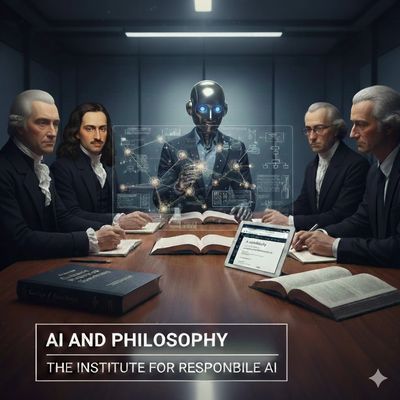
Whitepaper - Mapping Philosophy to AI Models
Abstract
The development of artificial intelligence is humanity's latest chapter in an ancient quest to understand intelligence and meaning. This whitepaper explores how four fundamental philosophical traditions find expression in AI architectures. Immanuel Kant's rationalism manifests in symbolic AI and rule-based expert systems. David Hume's empiricism appears in neural networks and large language models. Baruch Spinoza's deterministic monism emerges in agentic AI systems. Gottfried Leibniz's informational pluralism anticipates quantum-computational architectures.
Understanding these philosophical foundations provide insight into the thinking and methods of how different AI systems operate while providing context for modern responsible development and governance.
The Ancient Quest for Understanding Intelligence
For millennia humanity has been deeply intrigued and has investigated innumerable angles to understand intelligence. Philosophical traditions offer different answers to knowledge's origins. Rationalists argue fundamental knowledge exists innately. Empiricists counter that knowledge derives from sensory experience. Monist philosophers propose that mind and matter constitute aspects of unified substance. Pluralists suggest reality comprises multiple informational states existing in parallel. These philosophical positions provide frameworks for understanding modern AI architectures.
Kant and Rule-Based Expert Systems
Immanuel Kant argued that human minds possess innate structures, categories of understanding, that organize sensory experience. Knowledge requires both sensory input and conceptual structure. [1]
Kant's philosophy directly aligns with rule-based expert systems. These systems represent knowledge explicitly through if-then rules. A medical diagnostic expert system might encode "if patient has fever and cough and a chest x-ray shows infiltrates, then diagnose pneumonia." Expert systems achieved notable successes. Early expert systems like MYCIN diagnosed blood infections with accuracy comparable to specialists, and DENDRAL identified molecular structures. These days tax preparation systems guide users through complex regulations by applying explicit rules.
But, symbolic AI has fundamental limitations. The knowledge acquisition bottleneck makes building large rule bases difficult. Experts struggled to articulate tacit knowledge as explicit rules. Symbolic systems handled uncertainty poorly and fail at tasks humans perform effortlessly like visual perception, revealing that much intelligent behavior resists formalization into explicit logical rules.
Hume and Connectionist Architectures
David Hume argued that all knowledge derives from sensory experience through association of ideas. Complex concepts build from simpler impressions through repeated co-occurrence. [2]
Hume's philosophy finds expression in Artificial Neural Networks (ANN) and Large Language Models (LLM). Neural networks are make up of interconnected processing units with adjustable weights. Learning occurs through exposure to training examples. Knowledge exists implicitly in the connection weights, and networks trained on images learn object recognition without programmed rules.
Deep learning has achieved breakthrough successes. Convolutional Networks revolutionized computer vision. Large language models like GPT-4 demonstrated remarkable natural language understanding through pure pattern learning from massive datasets. But, connectionist systems face fundamental limitations, because neural networks operate as black boxes were knowledge resists interpretation. Neural nets require enormous training data and struggle with compositional generalization. Large language models hallucinate incorrect statements because their knowledge consists of statistical patterns and grounded understanding.
Spinoza and Agentic AI Systems
Baruch Spinoza argued that reality consists of a single substance. Mind and body represent parallel aspects of the same underlying reality, operating according to the same deterministic laws. [3]
Spinoza's deterministic monism maps to modern Agentic AI systems. AI Agents integrate perception, reasoning, and action in continuous feedback loops. Intelligence emerges from a unified dynamical processes where perception, cognition, and action continuously inform one another. For example, self driving cars integrate perception of road conditions, reasoning about traffic rules, and vehicle control in continuous loops. The vehicle's knowledge exists in the entire perception-reasoning-action cycle.
Active inference frameworks formalize this through mathematical models where agents minimize prediction error through both perception and action. Instead of passively receiving data or applying predetermined categories, active inference agents simultaneously predict sensory input and act to confirm predictions. The agent and environment form a unified system.
Other examples are applications like coordinated drone swarms or multi-robot manufacturing. These applications are examples of multi-agent systems where many independant AI agents interact. Each agent's behavior emerges from continuous interaction with other agents and the shared environment.
Leibniz and Quantum-Computational Architectures
Gottfried Leibniz proposed that reality consists of infinite monads, simple substances that each reflect the universe from their unique perspective. Leibniz's informational pluralism suggested that multiple informational states could exist simultaneously. [4]
Leibniz's philosophy anticipated Quantum-Computational architecture. Quantum computing exploits superposition, allowing quantum bits (Qbits) to exist in multiple states simultaneously. This enables quantum computers to explore vast solution spaces in parallel, processing multiple informational perspectives simultaneously. Like Leibniz's monads reflecting the universe from different perspectives, quantum states represent multiple informational configurations existing in superposition.
Quantum machine learning algorithms demonstrate an approach that fits well with Leibniz’s thinking. Quantum algorithms encode data into quantum states that exist in superposition, enabling simultaneous exploration of multiple solution paths. Current research in quantum neural networks process information through quantum gates that manipulate superposed states, potentially achieving computational advantages for certain problems. Quantum optimization algorithms like quantum annealing[5] tackle complex optimization by encoding solutions as quantum states and allowing the system to evolve toward optimal configurations through quantum tunneling[6]. Applications in drug discovery, materials science, and logistics optimization demonstrate quantum computing's potential.
Quantum cryptography exploits entanglement, where quantum states of separated particles remain correlated in ways classical information cannot replicate. This enables fundamentally secure communication protocols. The distributed quantum information exists simultaneously across entangled particles, embodying Leibniz's vision of informational perspectives existing in pre-established harmony.
Philosophical Foundations and Legal Implications
The philosophical differences create distinct legal challenges. Kantian rule-based systems' transparency supports explainability requirements. For example, when an expert system denies a loan application, it can articulate specific rules, enabling meaningful explanation and regulatory oversight.
Hume’s neural network opacity creates challenges. When large language models generate advice, the decision emerges from billions of parameters, making explanation difficult. This complicates compliance with transparency regulations. Bias in training data can produce discriminatory outcomes without explicit discriminatory rules, challenging enforcement of anti-discrimination laws.
Spinoza and AI Agentic systems present novel challenges. For example, when a self-driving car makes many driving decisions through continuous perception-action loops, determining liability is complex. Decisions emerge from ongoing agent-environment interaction, and product liability frameworks developed for static products struggle to address systems that continuously adapt.
Leibniz and quantum systems introduce unprecedented challenges. Quantum computing's probabilistic nature means identical inputs may produce different outputs due to quantum measurement's inherent randomness. This challenges legal requirements for consistency and reproducibility. When quantum algorithms contribute to consequential decisions, explaining outcomes requires understanding quantum mechanics, creating accessibility challenges. Intellectual property frameworks struggle to address quantum algorithm operation that are fundamentally different from classical computation.
Employment law confronts these philosophical differences. For example, algorithmic hiring using neural networks may perpetuate historical biases; agentic systems that adapt continuously to candidate interactions present consistency challenges; and, quantum systems that explore multiple solution spaces simultaneously introduce new considerations around determinism and explanation.
Healthcare regulation are similarly struggling to keep-up with these challenges. The FDA needs to develop frameworks that address systems ranging from transparent expert systems to opaque neural networks to adaptive agentic systems to probabilistic quantum algorithms.
Synthesis and Convergence
Modern AI research understands that no single philosophical tradition has a complete foundation for Artificial General Intelligence (AGI). Human intelligence combines Kant's structured reasoning; Hume's pattern learning; Spinoza's unified embodied cognition; and Leibniz's parallel informational processing – plus the thinking of many more deep thinkers, both ancient and modern.
An area of intense research is Neuro-Symbolic AI that integrates Kant's symbolic reasoning with Hume's neural learning. These hybrid systems use neural networks for perception while employing symbolic reasoning for logical inference. The addition of Spinoza's unified dynamics creates more powerful architectures. We are seeing the rise of systems that combine symbolic rules, learned patterns, and continuous sensorimotor feedback that can adapt while maintaining systematic reasoning.
Quantum-enhanced machine learning represents convergence of multiple traditions. Quantum neural networks combine Hume’s pattern learning with Leibniz parallel state exploration. Quantum optimization integrated with symbolic constraints merges Kant’s logical structure with Leibniz informational pluralism. Quantum-enhanced agentic systems could combine all four philosophical approaches, using quantum superposition to explore multiple action sequences while maintaining symbolic reasoning and unified agent-environment dynamics.
This philosophical synthesis extends to regulatory frameworks. Responsible AI governance should embrace insights from all traditions, requiring transparency for high-stakes decisions while acknowledging that intelligent behavior emerges from learned patterns, dynamical processes, and quantum informational states. Risk-based regulatory approaches imposing stronger requirements on higher-stakes systems reflect this balanced perspective.
Societal Benefits and Individual Preparation
Understanding AI's philosophical foundations lets us se these technologies to the fullest and in a responsible way. Kant’s expert systems are great for applications that require strict accountability and explicit reasoning. Hume’s neural networks work well for perception and prediction from complex data. Spinoza’s agentic systems fit applications requiring continuous adaptation to dynamic environments. Leibniz’s quantum systems suit problems requiring exploration of vast solution spaces or fundamentally secure communication.
We benefit from understanding philosophical foundations when we select AI tools and approaches. High-stakes decisions generally favor Kant neuro-symbolic approaches. Applications that learn from huge unstructured data map to Hume. Continuous environmental adaptation applications are guided from Spinoza’s unified thinking, and problems that need complex optimization or cryptography benefit from Leibniz’s quantum approach.
Education should be aware and teach these philosophical perspectives. Computer science education should include philosophy of mind and quantum mechanics alongside algorithms. Legal education should examine how different architectures create distinct regulatory challenges. Business education should explore philosophical foundations alongside technical capabilities.
The convergence of rationalist, empiricist, monist, and pluralist approaches suggests broader lessons about integrating different ways of learning and knowing. Responsible AI governance requires balancing competing values including innovation and safety, efficiency and accountability, adaptability and stability, classical determinism and quantum probabilism. Professional development need to emphasize philosophical literacy alongside technical competence.
Conclusion: Philosophical Foundations for Responsible AI
The future of Responsible AI depends on synthesizing insights from all philosophical traditions, creating systems that combine structured reasoning, learned patterns, unified dynamics, and quantum informational processing. We need to ground technical development in philosophical understanding, so that we can develop AI that serves humans while remaining understandable and governable.
The ancient philosophical questions that motivated Kant, Hume, Spinoza, and Leibniz remain relevant, guiding development of artificial intelligence that honors our capacity for logical reasoning, our ability to learn from experience, our embodied nature as adaptive agents, and our potential to harness quantum mechanical principles for computation.
FOOTNOTES
[1] Immanuel Kant's Critique of Pure Reason (1781) articulated that "thoughts without content are empty, intuitions without concepts are blind" (A51/B75), expressing that knowledge requires both innate conceptual structures and empirical content.
[2] David Hume's A Treatise of Human Nature (1739) argued that "all our ideas are nothing but copies of our impressions" (Book I, Part I, Section I), expressing his empiricism that knowledge derives from sensory experience.
[3] Baruch Spinoza's Ethics (1677) proposed that "the order and connection of ideas is the same as the order and connection of things" (Part II, Proposition 7), expressing his monism that mental and physical processes constitute parallel aspects of a single substance.
[4] Gottfried Wilhelm Leibniz's Monadology (1714) stated that "each monad is a living mirror of the universe" (§56), expressing his pluralism that reality comprises infinite simple substances, each reflecting the whole from its unique perspective.
[5] Quantum annealing is a computation method that finds optimal solutions by using quantum physics to explore many possibilities at once and settle into the lowest-energy (best) answer.
[6] Quantum tunneling is when a particle passes through a barrier that it normally wouldn’t have enough energy to cross, because its position is described by a probability wave rather than a fixed point.
REFERENCES
- Boden, M. A. (2006). Mind as Machine: A History of Cognitive Science. Oxford University Press.
- Friston, K. (2010). The Free-Energy Principle: A Unified Brain Theory? Nature Reviews Neuroscience, 11(2), 127-138.
- Garcez, A. d., Gori, M., Lamb, L. C., Serafini, L., Spranger, M., & Tran, S. N. (2019). Neural-Symbolic Computing: An Effective Methodology for Principled Integration of Machine Learning and Reasoning. Journal of Applied Logics, 6(4), 611-632.
- Haugeland, J. (1985). Artificial Intelligence: The Very Idea. MIT Press.
- Hume, D. (1739/2000). A Treatise of Human Nature. Oxford University Press.
- Kant, I. (1781/1998). Critique of Pure Reason (P. Guyer & A. W. Wood, Trans.). Cambridge University Press.
- Leibniz, G. W. (1714/1989). Monadology. In R. Ariew & D. Garber (Eds. & Trans.), Philosophical Essays (pp. 213-225). Hackett Publishing.
- Nielsen, M. A., & Chuang, I. L. (2010). Quantum Computation and Quantum Information (10th Anniversary ed.). Cambridge University Press.
- Preskill, J. (2018). Quantum Computing in the NISQ Era and Beyond. Quantum, 2, 79.
- Spinoza, B. (1677/1985). Ethics (E. Curley, Trans.). In The Collected Works of Spinoza (Vol. 1). Princeton University Press.
- Sutton, R. S., & Barto, A. G. (2018). Reinforcement Learning: An Introduction (2nd ed.). MIT Press.
- Wiebe, N., Braun, D., & Lloyd, S. (2012). Quantum Algorithm for Data Fitting. Physical Review Letters, 109(5), 050505