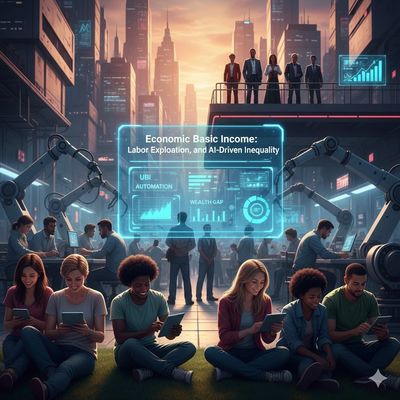
Whitepaper - Economic Impact and Implications
Abstract
Responsible AI, when guided by ethical principles and human-centered design, holds the power to elevate economic productivity, strengthen human capabilities, and create shared prosperity. This whitepaper explores how AI augments rather than displaces work, reduces mundane tasks, fosters innovation, and builds long-term resilience. By addressing transition challenges thoughtfully, society can harness AI to improve living standards, expand opportunity, and ensure that economic growth benefits individuals, businesses, and communities alike.
AI-Driven Productivity Gains
Artificial intelligence is a powerful force for productivity and growth. By handling repetitive, data-heavy tasks with speed and accuracy, AI frees workers to focus on higher-value activities that require creativity, judgment, and interpersonal skill. In manufacturing, for example, AI systems optimize supply chains in real time, predict maintenance needs, and reduce downtime, allowing teams to concentrate on innovation and quality improvement rather than routine monitoring. In professional services, AI tools draft reports, analyze data, and manage scheduling, giving lawyers, accountants, and consultants more time for client relationships and strategic thinking.
These gains extend beyond individual organizations. When businesses responsibly adopt AI, they often see faster revenue growth and stronger profitability, which in turn supports wage increases and job creation². Early adopters in sectors like technology, healthcare, and finance report that AI integration leads to more efficient operations and new product development¹. The result is a virtuous cycle: higher productivity generates resources that can be reinvested in people, infrastructure, and research, lifting the overall economy.
Enhancing Human Capabilities Through AI Collaboration
Far from replacing humans, Responsible AI acts as a collaborator that amplifies human strengths. Workers paired with well-designed AI tools consistently perform better than either alone. Customer-service agents supported by AI recommendations resolve issues faster while maintaining the warmth and empathy that customers value. Radiologists assisted by AI imaging tools detect subtle patterns more reliably, leading to earlier diagnoses and better patient outcomes. Software engineers using AI coding assistants complete projects more quickly and with fewer errors, allowing them to tackle complex architectural challenges.
This human-AI partnership is especially valuable in knowledge work. AI can synthesize vast amounts of information, spot trends, and generate options, leaving humans to evaluate, refine, and decide. The outcome is not just greater efficiency but also higher job satisfaction. Employees report feeling more effective, less bogged down by drudgery, and more engaged in meaningful work. In this way, Responsible AI elevates the quality of human interaction at work, turning routine exchanges into opportunities for connection and creativity.
Navigating Challenges: Stress, Transition Costs, and Responsible Mitigation
Change always brings (temporary) stress, and the shift toward AI-augmented work is no exception. Workers may feel uncertainty about new tools, and organizations face upfront costs for technology, training, and process redesign. Some roles will evolve significantly, requiring new skills. Responsible AI practices directly address these challenges. Organizations that involve employees in AI design, provide clear training pathways, and communicate transparently see smoother transitions and higher adoption rates.
Ethical frameworks ensure that Responsible AI systems are transparent, auditable, and aligned with human values, reducing the risk of unexpected errors or mistrust. When organizations prioritize worker well-being alongside efficiency, offering reskilling programs, flexible schedules during transitions, and support for mental health, the human costs of change diminish rapidly. The experience of leading firms shows that thoughtful implementation turns potential disruption into opportunity, with employees emerging more skilled and confident.
Broader Economic Implications for Society
The economic benefits of Responsible AI ripple outward. Higher productivity supports rising wages, stronger consumer spending, and increased tax revenues that fund public services. New industries and roles emerge around AI, data curators, AI ethicists, prompt engineers, system trainers, creating fresh career paths. Small and medium-sized businesses gain access to powerful tools once reserved for large corporations, leveling the playing field and spurring local innovation.
Over time, these dynamics raise living standards for all. More efficient healthcare lowers costs and improves access. Smarter logistics reduce waste and environmental impact. Personalized education and training become more affordable and effective, helping people adapt throughout their careers. The overall effect is an economy that grows more inclusive and dynamic, with opportunity expanding rather than contracting.
A Clear Vision for the Future: Preparation and Shared Prosperity
Looking ahead, we all stand to enjoy sustained economic expansion driven by Responsible AI³. Productivity gains will compound, leading to higher GDP per capita, stronger competitiveness, and greater national resilience. Individuals will enjoy more fulfilling work, better work-life balance, and continuous opportunities to learn and grow. Society will benefit from innovations that solve pressing problems in health, education, energy, and infrastructure.
Preparation is straightforward and empowering. Individuals can cultivate curiosity, embrace lifelong learning, and develop skills in critical thinking, creativity, and collaboration, areas where humans retain a lasting advantage. Businesses need to invest in people-first AI strategies, ethical governance, and inclusive training. Policymakers need to support this transition through accessible education, portable benefits, and incentives for responsible adoption.
By choosing responsible AI today, we position ourselves to lead in an era of abundance. The technology will not solve every challenge, but guided by human values it can dramatically improve economic opportunity, quality of life, and shared prosperity for generations to come.
FOOTNOTES
[1] McKinsey & Company (2025) reports that 64 percent of surveyed organizations state AI is enabling their innovation, with high performers achieving meaningful value through workflow redesign and growth-focused objectives.
[2] PwC (2025) observes that industries most exposed to AI have seen revenue growth per worker accelerate sharply since 2022, with wages rising twice as fast as in less-exposed sectors.
[3] Penn Wharton Budget Model (2025) projects that generative AI will lead to a permanent increase in the level of U.S. economic activity through productivity gains that persist even after initial adoption saturates.
REFERENCES
1. Stanford HAI. (2025). 2025 AI Index Report.
2. Penn Wharton Budget Model. (2025). The Projected Impact of Generative AI on Future Productivity Growth.
3. McKinsey & Company. (2025). The state of AI in 2025: Agents, innovation, and transformation.
4. PwC. (2025). The Fearless Future: 2025 Global AI Jobs Barometer.
5. Goldman Sachs Research. (2025). What Is the US Economy’s Potential Growth Rate?
6. Deloitte Insights. (2025). US Economic Forecast Q4 2025.
7. Anthropic. (2025). Anthropic Economic Index September 2025 Report.
8. MIT Sloan Management Review. (2025). How artificial intelligence impacts the US labor market.
9. Federal Reserve Board. (2025). The State of AI Competition in Advanced Economies.
10. Federal Reserve Bank of Dallas. (2025). Advances in AI will boost productivity, living standards over time.
11. Congressional Budget Office. (2024). Artificial Intelligence and Its Potential Effects on the Economy and the Federal Budget.
12. EY. (2025). How responsible AI translates investment into impact.