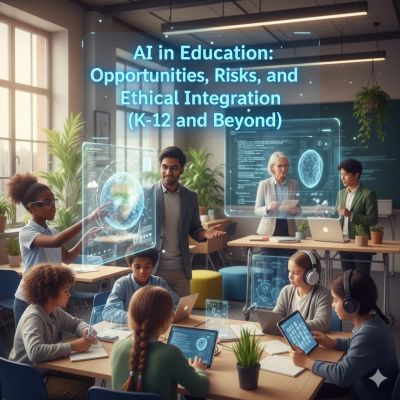
Whitepaper - AI Impact and Considerations for Education
The Paradigm Shift in Educational Delivery
The integration of Artificial Intelligence into the American educational system represents the most significant shift in educational methodology since the industrialization of the classroom. As we transition from a standardized, one-size-fits-all model to a data-driven environment, the primary objective is to enhance knowledge transfer while maintaining the human-centric values of mentorship¹ .
AI is an optimizer of human capital and it is a tool that reshapes how the next generation interacts with information. Responsible AI necessitates that this transition is managed with a focus on cognitive development and long-term societal stability rather than just short-term technological convenience.
Enhancing the Quality of Education through Personalization
The hallmark of AI in education is the ability to provide "precision learning²." In a traditional classroom, a teacher must aim their lecture at the median level of student understanding, often leaving advanced students bored and struggling students behind.
AI-driven adaptive learning platforms analyze a student's performance in real-time, identifying specific gaps in knowledge and adjusting the curriculum accordingly⁴ . For example, if a student in a high school physics class struggles with the concept of torque, the AI can pivot to provide supplementary modules on foundational mechanics before proceeding. This ensures that the quality of education is measured by mastery of the subject matter rather than mere seat time.
This level of personalization mimics the benefits of one-on-one tutoring, which has long been the gold standard of education but was previously too expensive to scale.
The Evolution of Teacher Workload and Instructional Capacity
One of the most immediate impacts of AI is the radical reduction of administrative burdens on educators. Currently, teachers spend a disproportionate amount of their time on grading, lesson planning, and attendance tracking. Automated grading systems, particularly for objective assessments and increasingly for essay-based assignments, allow teachers to reclaim hundreds of hours per year⁵ . This shift enables a "flipped classroom" model where the teacher moves from being a "sage on the stage" to a "guide on the side."
By delegating the rote aspects of instruction to AI, the teacher can focus on high-level mentorship, social-emotional development, and complex problem-solving discussions. However, this requires a new business model for schools where teachers are trained as AI orchestrators, ensuring that the technology is serving the curriculum rather than dictating it.
Student Engagement and the Gamification of Knowledge
Maintaining student engagement has become increasingly difficult in an era of digital distractions. AI offers a solution through the gamification and simulation of complex topics⁶. For example, instead of reading a textbook about the American Revolution, students can engage with AI-driven simulations that allow them to witness historical events or participate in mock debates with AI representations of historical figures.
This immersive approach creates a feedback loop that sustains interest and rewards curiosity. AI can monitor engagement levels by analyzing how long a student spends on a task or where they encounter friction, allowing the system to intervene with a different media format, such as switching from text to a video explanation, to maintain the student's interest⁷.
Cognitive Pitfalls and the Risk of Over-Reliance
While the benefits are substantial, the sociological impact of AI includes significant pitfalls, most notably the risk of "cognitive atrophy." If students rely on Generative AI to draft every essay or solve every mathematical equation, they may fail to develop the foundational critical thinking and synthesis skills required for professional life. There is a delicate balance between using AI as a calculator for the mind and using it as a replacement for thought³.
Responsible AI implementation in schools need to focus on "friction by design," where the technology assists the student but still requires them to perform the heavy lifting of analysis. Over-reliance can lead to a generation that knows how to prompt an AI but does not understand the underlying logic of the output, creating a fragile workforce that cannot function without a digital intermediary.
The Integrity of Assessment and Academic Honesty
The rise of large language models has disrupted the traditional homework-based assessment model. When AI can produce a passing essay in seconds, the "take-home" assignment loses its validity as a measure of student learning. This necessitates a shift back to in-class, proctored assessments and a move toward "process-based grading."
In this new-again framework, students are graded on their ability to show their work, explain their reasoning, and demonstrate how they used AI to reach a conclusion. This prepares students for a modern business environment where the value lies not in the raw output, but in the verification, refinement, and ethical oversight of AI-generated content.
Economic Considerations and the Cost of Implementation
The cost of AI in education is a dual-edged sword. The initial capital expenditure for hardware, high-speed connectivity, and software licenses is substantial. But the long-term ROI is found in the increased efficiency of the educational system and the better alignment of student skills with the needs of the 10-trillion-dollar US labor market⁸.
Schools should move away from expensive, static textbooks toward subscription-based AI platforms that stay current with evolving knowledge. There is also a significant cost associated with the professional development of the existing workforce; teachers who are not literate in AI will become a bottleneck to progress, making continuous training a non-negotiable line item in school budgets.
The Future of the Individual in an AI-Enhanced Society
As AI becomes the primary interface for learning, the individual must prepare for a future defined by "lifelong upskilling." The traditional model of education ending when a student reaches their early twenties is obsolete.
The AI-enabled individual will need to be an agile learner, using AI tutors throughout their career to pivot as industries are disrupted. Preparedness involves developing a high degree of "AI Literacy," which includes understanding the ethics of data, the nature of algorithmic bias, and the ability to discern fact from AI-generated hallucination.
The goal of education in the age of AI is to produce "human-plus" workers, individuals who possess deep empathy, ethical judgment, and creative vision, augmented by the computational power of artificial intelligence¹⁰ .
Societal Preparedness and Strategic Oversight
For the U.S. to remain competitive, the integration of AI into our educational system must be governed by a framework of strategic oversight⁹ . This involves collaboration between the government, technology firms, and sociological researchers to ensure that data privacy is paramount.
The data generated by a student’s learning journey is incredibly sensitive; if mishandled, it could lead to predictive profiling that limits a child’s future opportunities based on early-life performance. A responsible society should implement "data expiration" policies and ensure that AI serves as a ladder for improvement not as a digital permanent record of failure. By focusing on these considerations, the US can build an educational system that is both technologically advanced and profoundly human.
FOOTNOTES
- US Department of Education (2023). Artificial Intelligence and the Future of Teaching and Learning.
- Bloom, B. (1984). The 2 Sigma Problem.
- Goldstein, J., et al. (2024). Generative AI in the American High School.
- Luckin, R. (2018). Machine Learning and Human Intelligence.
- Microsoft Research (2024). The Productivity of Educators in an AI-First Environment.
- Stanford HAI (2024). AI Index Report: Education Chapter.
- OECD (2023). Future of Education and Skills 2030.
- Gartner (2024). Top Strategic Technology Trends in Education.
- MIT Media Lab (2023). Ethics of AI in the Classroom.
- World Economic Forum (2024). The Future of Jobs Report.
REFERENCES
- Bostrom, N. (2014). Superintelligence: Paths, Dangers, Strategies. Oxford University Press.
- Brynjolfsson, E., & McAfee, A. (2014). The Second Machine Age: Work, Progress, and Prosperity in a Time of Brilliant Technologies. W. W. Norton & Company.
- Darling-Hammond, L. (2021). The Flat World and Education: How America's Commitment to Equity Will Determine Our Future.
- Dweck, C. S. (2006). Mindset: The New Psychology of Success. Random House.
- Hattie, J. (2008). Visible Learning: A Synthesis of Over 800 Meta-Analyses Relating to Achievement. Routledge.
- Marr, B. (2019). Artificial Intelligence in Practice. Wiley.
- Pinker, S. (2018). Enlightenment Now: The Case for Reason, Science, Humanism, and Progress. Viking. (
- Reich, J. (2020). Failure to Disrupt: Why Technology Alone Can’t Transform Education. Harvard University Press.
- Selwyn, N. (2019). Should Robots Replace Teachers?
- Turkle, S. (2015). Reclaiming Conversation: The Power of Talk in a Digital Age. Penguin Press.