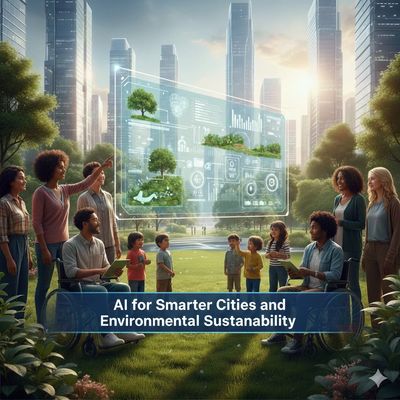
Smart Cities
Whitepaper - Smart Cities
Abstract
Responsible Artificial Intelligence (RAI) is transforming cities into smarter, more responsive environments that deliver measurable improvements in daily life. By integrating AI with sensors, data analytics, and connected infrastructure, municipalities are optimizing traffic flow, conserving energy, enhancing public safety, and streamlining services. When guided by transparent, accountable, and human-centered principles, these systems reduce operational costs, ease everyday stresses, and create opportunities for economic growth that benefit residents, businesses, and communities alike. This whitepaper explores the contributions of AI to urban living, highlights real-world examples, addresses manageable challenges through responsible practices, and outlines a clear path forward for individuals and society.
The Promise of AI-Enabled Smart Cities
American cities face growing demands on infrastructure, mobility, and public services. Responsible AI offers practical solutions by turning vast streams of urban data into actionable intelligence. Cities deploy sensors, cameras, and digital twins, virtual replicas of physical systems, to monitor conditions in real time and respond proactively. The result is a shift from reactive maintenance to predictive management, freeing resources for higher-value initiatives. In cities such as New York and Chattanooga, TN, AI-powered traffic systems adjust signals dynamically, shortening commute times and lowering vehicle emissions without requiring massive new construction. These applications demonstrate how AI can make existing infrastructure work harder and more intelligently, delivering tangible relief to residents while supporting long-term economic vitality.
AI Enhancing Urban Efficiency and Sustainability
AI drives efficiency in core municipal functions. Predictive analytics forecast water-main breaks, as seen in Tucson, Arizona, where algorithms analyze pipe data to schedule repairs before failures occur, avoiding costly emergencies and conserving water. In Memphis, Tennessee, AI-enabled video analytics detect incidents across a citywide camera network, enabling faster emergency response and smoother traffic recovery. Similarly, AI for energy management provides benefits: Seattle has used AI to optimize traffic signals, reducing emissions and fuel consumption. Streetlights in Denver and Miami dim automatically when not needed, cutting electricity use and extending equipment life. These examples illustrate a pattern, AI identifies waste, anticipates needs, and allocates resources more precisely, lowering taxpayer costs while smart parking systems in San Francisco and Boston guide drivers to open spaces advancing sustainability goals that improve air quality and neighborhood livability for everyone. [1], [3]
Improving Human Interaction and Quality of Life
AI augments rather than replaces human capabilities, making city services more accessible and responsive. Chatbots in Ann Arbor, Michigan, and Dearborn, Michigan, answer resident questions 24/7 in multiple languages, reducing wait times and allowing city staff to focus on complex issues. Smart parking systems in San Francisco and Boston guide drivers to open spaces, easing the frustration of circling blocks². Public-safety applications, like AI-assisted monitoring in Washington, D.C., help officers respond to emerging situations more effectively, contributing to safer streets without constant human surveillance. Residents experience less stress, more predictable routines, and greater confidence that their city government is working efficiently on their behalf.
Economic Advantages and Lifestyle Enhancements
The economic case for Responsible AI in Smart Cities is compelling. Reduced congestion and optimized logistics lower business operating costs and improve supply-chain reliability. Predictive maintenance extends the life of roads, bridges, and utilities, deferring expensive replacements and freeing municipal budgets for new investments. AI-enabled smart intersections optimize trucking routes, supporting local commerce and reducing delivery delays. Energy savings from intelligent lighting and building systems translate directly into lower utility bills for households and governments. Over time, these efficiencies create a virtuous cycle: healthier budgets enable better services, which attract residents and businesses, which expand the tax base and fund further innovation. Individuals enjoy shorter commutes, cleaner air, and more reliable services, improvements that enhance quality of life and free time for family, education, and recreation.
Navigating Challenges with Responsible AI
No technology is without risks, yet responsible frameworks turn potential pitfalls into manageable considerations. Privacy concerns are addressed through clear data-governance policies and human oversight, ensuring systems collect only necessary information and retain it securely. Transparency initiatives, such as public explanations of AI use, build trust. The National Institute of Standards and Technology (NIST) AI Risk Management Framework provides voluntary guidance that many cities adapt to evaluate impacts before deployment⁴. Cities like Seattle and San Jose have established oversight committees and procurement standards that require vendors to demonstrate fairness, explainability, and accountability⁵. By embedding these practices from the outset, municipalities avoid costly missteps and maintain public confidence, allowing innovation to proceed responsibly.
Envisioning the Future of Smart Cities
Looking ahead, AI will integrate more deeply with 5G networks, edge computing, and digital twins to create truly anticipatory urban systems. Cities will predict and prevent traffic jams before they form, reroute emergency vehicles around incidents in real time, and adjust energy distribution to match renewable supply. Public services will become more personalized, residents might receive tailored alerts about road closures or service disruptions through familiar apps, while human professionals retain final authority on sensitive decisions. The economic outlook is uplifting: job growth in AI-related fields, from data analysis to system maintenance, will complement traditional roles, and productivity gains will support wage growth and community investment. American cities stand poised to lead globally in demonstrating how technology can serve people, strengthen economies, and enhance everyday living.
Preparing for an AI-Driven Urban Future
Society and individuals can prepare through practical, forward-looking steps. Municipalities should continue building public-private partnerships that share expertise and risk, adopt frameworks such as NIST’s for consistent risk management, and invest in workforce training so current employees can thrive alongside new tools.
Individuals benefit by developing digital literacy, learning to use city apps, understanding basic data privacy, and participating in public forums about technology deployment. Lifelong learning programs, community workshops, and accessible online resources will help everyone adapt comfortably. Businesses can contribute by piloting responsible AI solutions and sharing lessons learned.
When citizens, governments, and industry collaborate with clear ethical guardrails, the transition to smarter cities becomes an opportunity for shared prosperity rather than disruption.
FOOTNOTES
[1] National League of Cities. (2025). AI in Cities Report, pp. 25-27
[2] Sand Technologies. (2024). Smart Cities in the U.S.: 14 Success Stories
[3] OECD. (2025). Artificial Intelligence for Advancing Smart Cities (
[4] National Institute of Standards and Technology. (2023). AI Risk Management Framework
[5] City of Seattle. (2025). Responsible Artificial Intelligence Policy and 2025–2026 AI Plan
REFERENCES
1. National League of Cities. (2025). AI in Cities Report. https://www.nlc.org/wp-content/uploads/2025/01/AI-in-Cities-Report.pdf
2. Organization for Economic Co-operation and Development. (2025). Artificial Intelligence for Advancing Smart Cities. https://www.oecd.org/content/dam/oecd/en/about/programmes/cfe/the-oecd-programme-on-smart-cities-and-inclusive-growth/Issues-Note-AI-for-advancing-smart-cities.pdf
3. National Institute of Standards and Technology. (2023). Artificial Intelligence Risk Management Framework (AI RMF 1.0). https://www.nist.gov/itl/ai-risk-management-framework
4. Sand Technologies. (2024). Smart Cities in the U.S.: 14 Success Stories. https://www.sandtech.com/insight/smart-cities-in-the-us/
5. City of Seattle. (2025). Responsible Artificial Intelligence Policy. https://www.seattle.gov/tech/data-privacy/the-citys-responsible-use-of-artificial-intelligence
6. U.S. Department of Transportation. (2025). SMART Grants Program. https://www.transportation.gov/grants/SMART
7. U.S. Department of Transportation. (2025). Artificial Intelligence Activities. https://www.transportation.gov/AI
8. UN-Habitat. (2024). Global Assessment of Responsible AI in Cities. https://unhabitat.org/sites/default/files/2024/08/global_assessment_of_responsible_ai_in_cities_21082024.pdf
9. National Association of State Chief Information Officers. (2025). State CIO Survey. (Referenced in Smart Cities Dive reporting on GenAI adoption).
10. IEEE Smart Cities. (2024–2025). Various technical resources on AI integration and responsible frameworks (cross-referenced in OECD and NIST materials).
11. Brookings Institution. (2024). Responsible AI resources (contextual policy landscape).